


English
Views: 0 Author: Site Editor Publish Time: 2026-09-28 Origin: Site


WPC wall panels can be used across hotel guest rooms, corridors, reception areas, restaurants, lounges, lift lobbies, meeting rooms, and decorative feature walls. For project buyers, however, choosing panels from a color card is not enough. A hotel installation may involve thousands of square meters, repeated room layouts, several installation teams, phased deliveries, and strict requirements for appearance, fire documentation, cleaning, dimensional consistency, and replacement stock.
A specification problem that seems small during sampling can become expensive after installation begins. Inconsistent panel widths can shift joint lines across a corridor. Mixed color batches can become visible under hotel lighting. Incorrect panel lengths create unnecessary cutting and waste. A fire-test report that does not correspond to the ordered construction may also be unsuitable for project approval.
Shandong Demax Group supplies WPC Wall Panels for residential and commercial interiors, including hotel decoration. Before requesting a bulk quotation, hotel owners, contractors, designers, distributors, and procurement teams should confirm the following eight specifications.
Start with the actual panel profile rather than simply writing “WPC wall panel” in the RFQ.
Hotel wall systems can use fluted profiles, rounded profiles, flat decorative surfaces, irregular profiles, wood-look designs, or other customized sections. The profile influences appearance, usable coverage width, shadow lines, joint pattern, installation method, trim selection, wall build-up, and material consumption.
Shandong Demax Group currently offers several Interior WPC Wall Panel designs. Its WPC Fluted Wall Panel, for example, lists profile sizes such as 155 × 18mm, 165 × 22mm, and 170 × 24mm, while its Inner Circular Wall Panel includes 159 × 15mm and 204 × 12mm options.
These dimensions should not be treated as interchangeable. A change in width or profile depth affects how many panels are required, how joints align with doors and furniture, and whether existing trims remain compatible.
Material construction should also be confirmed. Demax's current WPC pages describe a wood-plastic composite formulation based on wood powder and polymer components. For a hotel project, buyers should request the technical data for the exact ordered SKU rather than relying only on a general WPC description.
A strong RFQ should therefore identify:
Panel model or profile drawing
Overall width
Effective coverage width
Thickness
Profile depth
Material formulation or product grade
Indoor or exterior application
Required quantity in square meters or linear meters
For customized sections, include a cross-sectional drawing. This is particularly useful when architects want a specific flute spacing, groove depth, curved profile, or repeated decorative rhythm across several hotel areas.
Hotel projects depend heavily on dimensional consistency because the same wall detail is often repeated across dozens or hundreds of rooms.
A panel can look correct when inspected individually but still create installation problems if its dimensions vary across the batch. Width variation changes joint alignment. Thickness differences create uneven surfaces. Warped panels may not sit flat against the substrate. Inaccurate tongue-and-groove geometry can produce loose joints or make installation unnecessarily difficult.
Demax's own dimensional-control guidance identifies length, width, thickness, groove width, tongue size, profile depth, edge straightness, flatness, and warpage as important inspection points for bulk WPC wall panel orders.
For hotel projects, panel length deserves particular attention.
If guest-room walls have a finished height close to the standard panel length, ordering project-specific lengths can reduce site cutting, waste, dust, and installation labor. A corridor with a different ceiling height may require another length. Procurement teams should therefore create a length schedule instead of ordering one generic size for the entire hotel.
The RFQ should state:
Nominal panel length
Width
Thickness
Dimensional tolerance
Straightness requirement
Flatness requirement
Groove/tongue fit
Custom cutting requirements
Quantity by size
For example:
Guest rooms: 2850mm finished panel length — 3,800 pcs
Corridors: 3000mm finished panel length — 1,200 pcs
Lobby feature walls: custom cutting schedule attached
This is more useful than ordering by total area alone.
For repeat or phased deliveries, dimensional consistency should also be maintained between batches. If phase two is delivered six months after phase one, the contractor should still be able to combine replacement panels with the original installation without visible profile or joint differences.
Hotels use lighting intentionally. Warm LED lighting, directional spotlights, natural daylight, wall washers, and decorative fixtures can make color variation more visible than it appeared on a small sample.
This is why color approval should cover more than a product photograph or digital color chart.
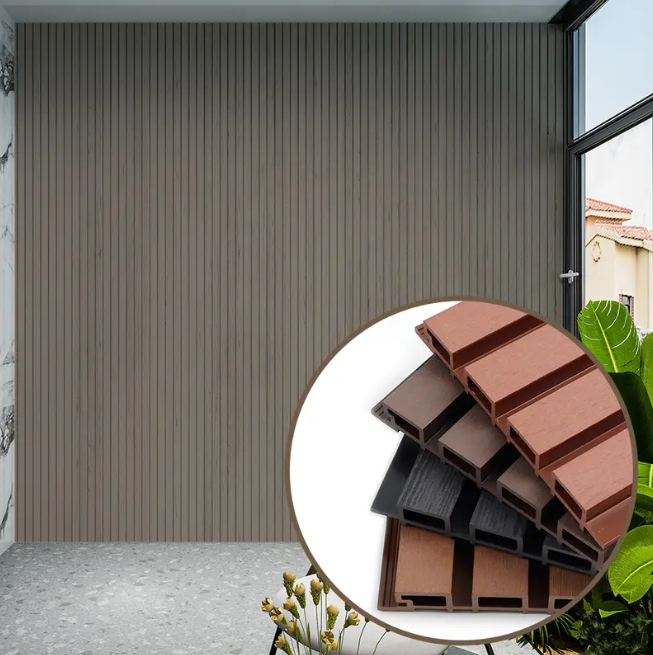
Demax offers white, grey, black, wood-look, and customizable finishes across current WPC products. For a project involving hundreds of rooms, buyers should approve a physical master sample showing the actual profile, color, grain direction, texture, gloss, and surface treatment.
The RFQ should specify:
Product color code
Wood-grain pattern if applicable
Surface texture
Gloss or matte appearance
Approved physical sample
Grain direction
Batch consistency requirement
Replacement-panel requirement
Batch consistency matters because color can be influenced by raw materials, surface film, coating, embossing, gloss, texture, and viewing angle. Demax also specifically addresses batch color consistency in its project guidance, noting that differences become more visible across large hotel walls, corridors, retail spaces, and other repeated installations.
Where possible, order panels for one continuous visible area from the same production batch. A 50-meter corridor should not be divided casually between unrelated color batches if the panels will sit directly beside one another.
It is also useful to purchase spare material during the original project. Hotels experience maintenance damage over time, and a replacement panel ordered several years later may not perfectly match the original batch.
A practical project specification might therefore include an additional percentage of matching panels for future maintenance, with cartons clearly labeled and stored by hotel zone or finish code.
Fire performance is particularly important in hospitality projects because hotels contain sleeping accommodation, public circulation areas, restaurants, meeting spaces, and other occupancy zones that may be subject to specific building-code requirements.
Demax's general WPC specification page currently lists B1 fire resistance and E0 environmental protection information for its WPC wall panel range. However, buyers should not assume that every panel profile, thickness, surface finish, substrate, and installation assembly automatically has the same tested classification.
Before ordering, ask for documentation relating to the exact material being proposed.
The RFQ should identify:
Required fire standard
Required classification
Project country
Installation zone
Panel SKU
Panel thickness
Surface finish
Test-report requirement
Emission or environmental requirement
Any architect or consultant documentation requirements
Fire testing is especially important because certification may apply to a specific specimen construction. Changes in panel thickness, surface layer, backing, fixing method, air cavity, or substrate may affect whether the available evidence matches the installed assembly.
The procurement team should therefore coordinate with the architect, fire consultant, contractor, and local authority rather than asking only whether the panel is “fireproof.”
The same principle applies to environmental and emissions claims. If an E0, formaldehyde, VOC, CE, SGS, or other document is required in the project submittal, specify that requirement before purchase and confirm that the available document covers the product actually being supplied.
A cheaper panel becomes expensive if it is delivered to site and later rejected because the required project documentation was never confirmed.
WPC is often selected for hotel interiors because it offers good moisture resistance and lower maintenance than natural wood, but “moisture resistant” should not be interpreted as permission to install the same panel in every wet environment without further design review.
A guest-room feature wall, corridor wall, reception desk backdrop, bathroom entrance wall, spa area, and shower enclosure do not have identical exposure conditions.
Demax lists moisture-proof, waterproof, mould-resistant, and easy-clean characteristics across its interior WPC products, and hotel decoration is specifically included among current applications.
For procurement, buyers should identify the actual hotel zone:
Guest room
Corridor
Lobby
Restaurant
Meeting room
Lift lobby
Bathroom entrance
Spa or high-humidity area
Back-of-house area
Then explain the expected cleaning method and moisture exposure.
Hotel maintenance teams may clean walls repeatedly with damp cloths or commercial cleaners. High-touch public spaces may receive more frequent cleaning than decorative walls inside guest rooms. Buyers should therefore confirm acceptable cleaning agents and request cleaning guidance for the proposed surface.
The wall substrate must also be considered.
Even a moisture-resistant panel can experience installation problems when bonded onto a damp or unstable wall. Demax's project guidance emphasizes checking substrate dryness, cleanliness, flatness, water seepage, room humidity, and adhesive conditions before installation.
If the hotel project includes recently completed plaster, concrete, or other wet construction work, installation scheduling should allow the substrate to reach appropriate conditions before wall panels are fixed.
Moisture resistance is a material property. It does not replace good waterproofing, wall preparation, drainage design, or suitable adhesive selection in genuinely wet locations.
A hotel wall panel order is incomplete without installation accessories.
The same panel can look completely different depending on how inside corners, outside corners, door frames, skirting boards, ceiling lines, panel ends, and transitions to other materials are handled.
Demax's current interior WPC products support glued or nailed installation, and its installation guidance also describes adhesive application and clip or nail fixing depending on the profile. Shandong Demax Group also presents installation accessories and installation support as part of its project service.
Before ordering, provide:
Wall substrate
Installation method
Adhesive requirement
Clip/nail system
Inside-corner detail
Outside-corner detail
End trim
Ceiling transition
Skirting detail
Door-frame detail
Window-frame detail
Expansion allowance
Installation drawings
Expansion allowance should not be ignored.
WPC is generally more dimensionally stable than natural timber, but it can still respond to temperature, humidity, transport conditions, and installation stress. Demax's current installation guidance notes that concealed perimeter gaps are commonly planned around fixed boundaries, with the final allowance depending on profile, wall length, room conditions, trims, and installation method.
For large hotel projects, ask the supplier to review a typical room elevation before production.
One approved wall detail can then become the installation standard for repeated guest rooms. This reduces interpretation between different subcontractor teams and makes it easier to estimate panels, trims, adhesives, and waste.
A mock-up room is particularly valuable. Before thousands of panels are shipped, the project team can review joint alignment, corners, lighting, furniture interfaces, skirting, cleaning, and overall appearance using the real installation system.
Hotel procurement should be organized around installation zones rather than one total quantity.
A hotel may contain several panel finishes:
Guest-room headboard wall
Corridor wall
Lift lobby
Reception background
Restaurant wall
Executive lounge
Meeting room
If all materials arrive mixed in identical cartons, contractors spend additional time sorting them on site. Incorrect panels may also be delivered to the wrong floor.
A better RFQ contains a room or zone schedule:
| Hotel Area | Panel | Finish | Length | Quantity |
|---|---|---|---|---|
| Standard Guest Room | Fluted WPC | Walnut | 2850mm | 2,400 pcs |
| Executive Room | Fluted WPC | Dark Oak | 2850mm | 650 pcs |
| Corridor | WPC Panel | Grey Oak | 3000mm | 1,100 pcs |
| Lobby | Custom Profile | Dark Walnut | Custom | 320 pcs |
The supplier can then plan production, packaging, labels, and shipment phases around the project schedule.
Waste allowance should be calculated from real installation conditions. Straight repeated walls may have relatively efficient material utilization, while areas with numerous doors, corners, columns, short returns, and custom cuts may require more allowance.
Packaging should protect long decorative panels against:
Surface scratching
Edge impact
Profile deformation
Moisture during storage
Incorrect batch mixing
Bending during transport
Cartons should also be clearly labeled with product model, color, length, batch number, quantity, and hotel zone where appropriate.
For phased projects, ask whether shipments can be organized by floor, building, room type, or construction stage. A slightly higher packing cost can sometimes save substantial labor during installation.
The last specification is not a panel dimension. It is the project-control process.
Before mass production, hotel buyers should approve a production-representative sample containing the actual profile, thickness, color, surface treatment, joint design, and preferably the relevant trim.
For larger projects, a sample board alone may not be enough. A full-size mock-up or model room can reveal problems that a 300mm sample cannot show, including repeated joint rhythm, lighting effects, wall flatness, corner details, and compatibility with furniture.
Inspection requirements should be agreed before shipment.
For WPC hotel panels, useful checks include:
Length
Width
Thickness
Profile accuracy
Tongue-and-groove fit
Straightness
Flatness
Warpage
Surface defects
Color consistency
Trim compatibility
Batch labels
Packaging condition
Shandong Demax Group's own quality-control guidance describes first-article inspection, in-process checks, batch sampling, dimensional inspection, fit checks, and final packaging review as relevant controls for bulk WPC panel orders.
Lead time should also reflect phased hotel construction.
Confirm:
Sample lead time
Mock-up quantity
Production lead time
Monthly production capacity
Shipping schedule
Phase-one quantity
Phase-two quantity
Replacement stock
Repeat-order support
Hotel openings often have fixed deadlines. A late replacement order for 50 damaged panels can sometimes create more operational difficulty than the original thousand-panel shipment.
Discuss replacement support from the beginning, including whether the supplier can retain product records, color references, and production specifications for future orders.
A complete RFQ can be summarized in one table.
| RFQ Item | Example Information |
|---|---|
| Project | 300-Room Business Hotel |
| Application | Guest Rooms + Corridors |
| Product | Interior WPC Wall Panel |
| Profile | Fluted |
| Size | 165 × 22mm |
| Length | 2850mm / 3000mm |
| Finish | Walnut Wood Grain |
| Color Standard | Approved Physical Sample |
| Fire Requirement | Project Standard Attached |
| Emission Requirement | Project Standard Attached |
| Installation | Adhesive + Mechanical Fixing |
| Substrate | Interior Finished Wall |
| Trims | Corners + Ends + Skirting Interface |
| Quantity | Schedule Attached |
| Spare Material | Required |
| Packaging | Labeled by Hotel Zone |
| Inspection | Dimensions + Color + Surface + Fit |
| Delivery | Phased by Construction Schedule |
This is much more useful than requesting:
“Please quote WPC wall panels for a hotel.”
A detailed specification enables suppliers to calculate panel quantities, custom lengths, trims, production batches, packaging, documentation, and project logistics more accurately.
Two WPC quotations should only be compared after the technical scope is standardized.
A lower-priced offer may use a different panel width, thinner profile, simpler surface film, different material formulation, fewer accessories, generic packaging, or no project-specific inspection.
A more complete quotation may already include custom lengths, matching trims, physical samples, batch labeling, spare material, export packaging, and technical documentation.
Compare at least:
Profile and dimensions
Material construction
Effective coverage
Surface finish
Color consistency
Fire documentation
Environmental documentation
Accessories
Custom cutting
Packaging
Quantity per carton
Inspection
Replacement supply
Delivery schedule
The correct comparison is the cost of an installed and approved hotel wall system, not only the price per panel.
Shandong Demax Group offers a broader WPC Wall Panel portfolio along with interior profiles, customized colors and sizes, installation accessories, and project support. This makes it possible to discuss the panel, trims, project quantities, and installation conditions within the same sourcing process.
Buying WPC Wall Panels for a hotel project requires more than selecting a wood-grain finish from a catalog.
Before ordering, buyers should confirm the panel profile and composition, dimensions and tolerances, color and batch standard, fire and emissions documentation, moisture exposure, installation system, project quantities, packaging, inspection, and delivery plan.
Hotel projects magnify small specification differences because the same detail is repeated across hundreds of rooms and long public areas. Good RFQ preparation therefore reduces more than purchasing risk. It can reduce cutting waste, installation delays, color mismatch, accessory shortages, rework, and future replacement problems.
Shandong Demax Group supplies Interior WPC Wall Panels, including WPC Fluted Wall Panels and customized decorative profiles for hotel and commercial interior applications.
The most effective hotel procurement process is to define the complete wall system, approve the physical sample and mock-up, confirm project documentation, and lock the production standard before mass manufacturing begins.
A: Include the panel profile, dimensions, length, color, surface finish, project zone, fire and environmental requirements, installation method, trims, quantity schedule, packaging, inspection, and delivery plan.
A: WPC wall panels can be used for hotel guest-room feature walls and decorative surfaces when the selected panel, finish, fire documentation, installation system, and maintenance requirements match the project specification.
A: Check length, width, thickness, effective coverage, profile depth, groove and tongue dimensions, straightness, flatness, and warpage. Custom lengths can also help reduce cutting during repetitive room installation.
A: Panels installed together across one visible wall or corridor should preferably have controlled color consistency. Large hotel projects should define approved samples, batch labeling, and repeat-order requirements before production.
A: WPC panels can offer strong moisture resistance, but suitability depends on the exact product and location. Shower or continuously wet areas still require appropriate waterproofing, substrate preparation, fixing systems, and project-specific approval.
A: The required rating depends on the country, hotel area, wall assembly, and applicable building regulations. Buyers should specify the required standard and verify that the test documentation applies to the exact panel construction being ordered.
A: Yes. Matching inside corners, outside corners, end details, skirting interfaces, and other accessories should be planned with the panel system so installation details remain consistent throughout the project.
A: A full-size mock-up helps verify panel color, joint rhythm, trim details, lighting appearance, wall preparation, installation method, and coordination with doors, furniture, ceilings, and skirting before the same detail is repeated across the project.


