


English
Views: 0 Author: Site Editor Publish Time: 2026-08-24 Origin: Site


Buyers evaluating interior treatments often prioritize visual aesthetics. Wood-slat finishes look stunning in modern spaces. However, the visual surface only tells half the story regarding room acoustics. The true acoustic workhorse hides out of sight. It is the porous backing material beneath the slats. Typically, manufacturers construct this from PET felt or mineral wool.
Many project managers mistakenly believe any backing solves their noise issues. The core reality proves quite different. Backing thickness specifically dictates which frequencies are actually attenuated. It does not merely increase total sound absorption. Over-specifying your panels wastes your procurement budget. Conversely, under-specifying them leaves disruptive echoes bouncing around the room.
We will break down how backing thickness impacts overall noise reduction. You will learn the science behind acoustic anatomy and material differences. We explore the powerful air gap strategy. Ultimately, this specification-level guide helps you choose the exact panel profile required to solve specific acoustic challenges effectively.
Understanding a modern acoustic panel requires looking at its dual-layer construction. We must separate the visual face from the hidden core. These components perform entirely different acoustic functions.
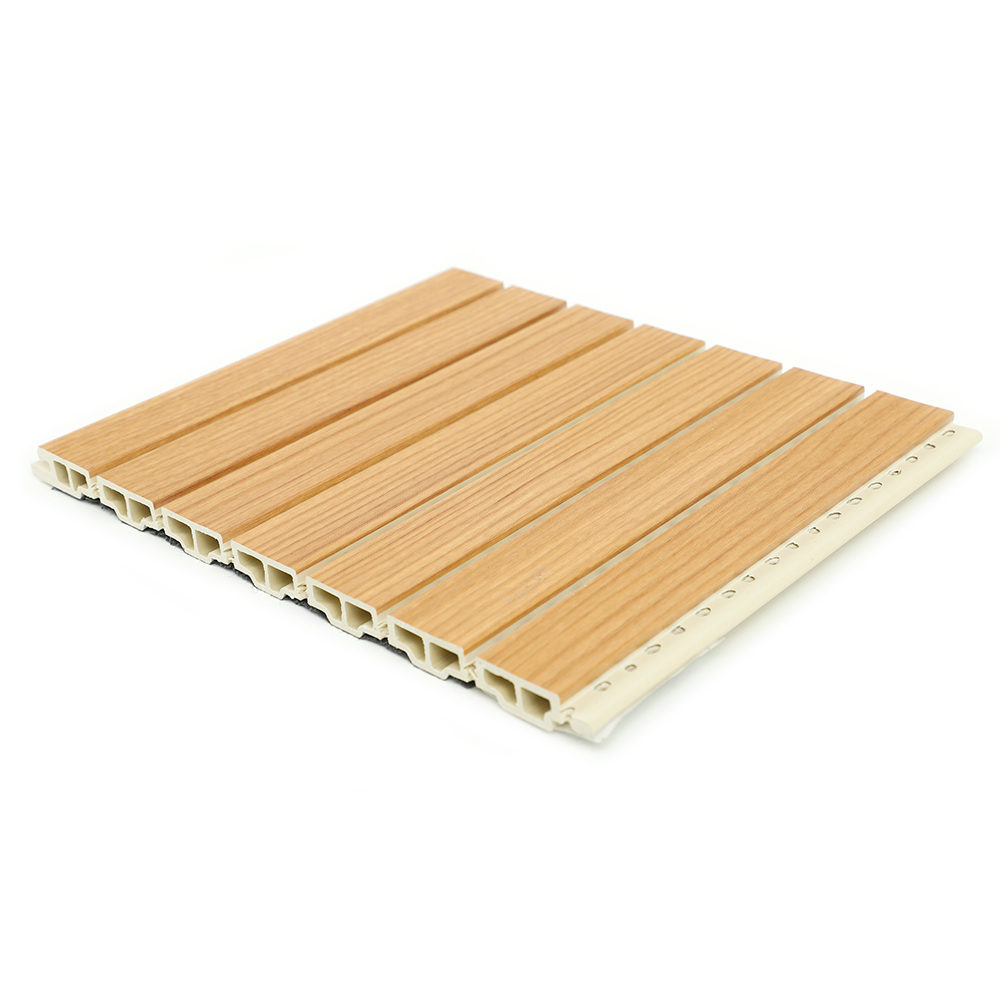
Wood Plastic Composite (WPC) slats act as reflective and diffusive elements. They feature rigid surfaces. Rigid materials bounce soundwaves rather than absorbing them. The slats break up direct soundwaves into smaller, scattered reflections. This scattering prevents interior spaces from sounding artificially "dead" or unnaturally quiet. High-quality diffusion maintains a lively but controlled room ambiance.
The felt or fiber backing handles the actual sound absorption. Sound energy passes directly through the calculated gaps between the slats. Once inside the porous backing, the soundwaves encounter dense, tangled fibers. Friction occurs as soundwaves navigate these fibers. This process converts acoustic energy into microscopic heat energy. We experience this energy loss as noise reduction.
Acousticians measure this absorption using the Noise Reduction Coefficient (NRC). The NRC scale ranges from 0.0 (perfect reflection) to 1.0 (perfect absorption). Increasing your backing thickness shifts the entire NRC curve. Thicker backings become highly effective across a broader frequency spectrum. Thinner profiles only capture the upper end of the frequency range.
Specifying the correct panel requires matching the material profile to your specific noise problem. We categorize backings into thin and thick profiles. Each serves a distinct acoustic purpose.
Table: Backing Thickness Performance Comparison
| Thickness Profile | Primary Frequency Range | Best Applications | Core Limitations |
|---|---|---|---|
| Thin (9mm - 12mm) | 1000 Hz and above | Offices, restaurants, meeting rooms | Fails to stop low-end rumble or bass |
| Thick (25mm - 50mm+) | 250 Hz - 500 Hz | Theaters, studios, industrial spaces | Heavier, requires robust hardware |
Most standard commercial panels utilize a 9mm to 12mm PET felt backing. This acoustic profile generates a high NRC for frequencies above 1000 Hz. You will notice a rapid absorption drop-off below 500 Hz. These profiles excel at resolving high-pitch flutter echoes. They mitigate office speech privacy issues effectively. They handle general restaurant clatter beautifully.
However, they possess a strict physical limitation. Thin backings cannot stop low-end rumble. They will never absorb heavy bass frequencies. A standard thin-backed WPC acoustic panel ignores HVAC vibrations completely.
Thick backings deliver broad-spectrum absorption. They effectively capture tricky mid-to-low frequencies between 250 Hz and 500 Hz. Project designers specify these robust profiles for demanding environments. They work best in home theaters and recording studios. Industrial spaces housing heavy machinery also require them.
Implementing thick backings introduces new physical realities. They carry a heavier footprint. You must install them using specialized mounting hardware. Standard construction adhesive often fails under their weight. Additionally, thicker profiles incur higher shipping and material costs. You must plan your logistics accordingly.
You can manipulate physics to achieve exceptional low-frequency absorption. The air gap strategy offers a brilliant workaround. It boosts acoustic performance without requiring prohibitively thick materials.
Acoustic engineers rely on the "quarter-wavelength rule." Soundwaves possess actual physical lengths based on their frequency. Low-frequency waves stretch several feet long. A soundwave reaches its highest particle velocity at exactly one-quarter of its total wavelength. Creating empty space behind your panel catches these waves at their maximum velocity point. This maximizes the absorption efficiency of the backing material.
Direct-to-wall mounting represents the most common installation method. Installers use glue or screws to attach panels directly to the drywall. This method saves space but limits low-frequency performance. Alternatively, you can mount panels on wooden furring strips. These wooden battens typically measure 1-inch to 2-inches thick. They stand the panel away from the wall, creating a sealed air cavity behind the backing.
This air gap strategy optimizes your procurement budget aggressively. Imagine buying a standard 12mm-backed WPC Acoustic Panel. Installing it directly against the wall yields standard high-frequency absorption. However, installing that exact same panel over a 50mm air gap changes everything. The resulting low-frequency absorption rivals a custom 60mm-thick panel. You achieve premium acoustic results while purchasing standard-priced materials.
The slat material sitting in front of the backing also warrants careful consideration. Manufacturers predominantly use two composite materials. We must evaluate how these materials interact with the backing layer.
We see stark differences when comparing core densities. A WPC acoustic panel utilizes wood fibers mixed with thermoplastic polymers. It feels noticeably heavier. It resists moisture inherently. Conversely, an MDF acoustic panel relies on pressed wood fibers and resin. It provides excellent rigidity but remains vulnerable to humidity.
The slat material marginally affects high-frequency scattering. Denser WPC slats reflect high notes slightly crisper than MDF slats. Despite this minor scattering variance, your backing requirement remains identical. If you need to absorb 500 Hz frequencies, you need the same backing thickness regardless of the slat material.
Environmental conditions dictate your final material selection. You might evaluate an MDF sound absorbing board for a climate-controlled boardroom. It performs flawlessly there. However, indoor pools and coastal hotels demand better structural stability. WPC represents the superior structural choice for high-humidity spaces. Crucially, the backing material must also survive these conditions. You must specify a hydrophobic backing. Closed-cell PET resists moisture effectively. Natural wool absorbs water and sags. You must match both the slat and the backing to the environment.
Choosing the correct acoustic treatment requires a systematic approach. Follow this checklist before submitting your final purchase order.
We have explored the intricate relationship between panel construction and noise reduction. Backing thickness operates as a highly targeted acoustic tool. It is never a simple "more is always better" metric. You must match the material profile directly to the specific frequencies causing your acoustic problems.
Remember these core takeaways. Thin backings control speech and clatter effectively. Thick backings capture disruptive low-end rumble. The physical density of the backing matters just as much as the depth. Furthermore, employing an air cavity behind standard panels offers massive performance gains without inflating your budget.
Before executing bulk orders for commercial fit-outs, take protective action. Consult with professional acoustic engineers regarding your space. Request physical samples and technical data sheets from your supplier. Reviewing actual lab reports ensures your chosen panels will perform exactly as expected in the real world.
A: No. Acoustic absorption operates on a principle of diminishing returns. Doubling the material thickness extends the absorption capabilities into much lower frequencies. However, it does not infinitely multiply the absorption of high frequencies. A 25mm panel will absorb bass better than a 12mm panel, but both will absorb high-pitch chatter similarly.
A: While technically possible, mixing undocumented materials introduces serious risks. Unrated acoustic foam compromises fire compliance and voids Class A fire ratings. It also yields highly unpredictable acoustic results. It remains much safer and more reliable to specify the correct backing thickness directly from the factory.
A: High-density PET backings add nominal weight compared to the heavy WPC slats themselves. The face slats contain most of the mass. However, transitioning from thin 9mm profiles to deep 50mm profiles shifts the center of gravity. This change may require heavy-duty mechanical anchors rather than relying on standard construction adhesive.


