


English
Views: 0 Author: Site Editor Publish Time: 2026-10-23 Origin: Site


How do you choose a WPC wall panel that balances style, durability, and cost? Commercial interiors demand more than attractive finishes. They need reliable performance and easy maintenance. This guide covers key specifications, installation needs, safety standards, and supplier selection to help you make informed purchasing decisions.
Start by identifying the conditions each wall surface will face. Office meeting rooms usually experience less physical contact than hotel corridors or busy retail entrances. Restaurant interiors may require more frequent cleaning. Reception areas also need finishes that maintain a consistent appearance under strong lighting and regular use. These differences should guide the choice of surface, profile, and mounting system.
For high-traffic locations, examine the panel's documented resistance to scratches, stains, and everyday impacts. Ask how the surface responds to routine cleaning products. A decorative finish may look attractive in a showroom but perform differently after months of commercial use. Sample testing can help buyers identify potential issues before approving a large order. It also allows designers to compare texture, color, and surface quality under realistic lighting conditions.
Moisture exposure deserves separate attention. A panel described as waterproof or moisture-resistant still needs application-specific evaluation. Confirm whether the claim applies to the panel surface, its core, its joints, or the complete installed assembly. Water may enter through exposed edges or poorly finished connections. Cleaning procedures and ventilation can also affect long-term performance. Create a room-by-room specification before requesting quotations. Record traffic levels, cleaning frequency, moisture exposure, and expected service conditions. This helps suppliers recommend relevant products and prevents buyers from comparing panels designed for different applications.
Panel thickness influences rigidity, weight, fixing requirements, and the finished wall's appearance. However, thicker panels are not automatically better. Their performance also depends on profile geometry, material composition, internal structure, manufacturing quality, and support spacing. Buyers should compare these factors together rather than choosing a product by thickness alone.
Large commercial walls require particular attention to flatness and alignment. Small dimensional differences can become noticeable across long corridors or continuous feature walls. Ask suppliers for panel dimensions, manufacturing tolerances, recommended support spacing, and installation instructions. Confirm whether the specified product can accommodate the project's wall height and layout without excessive cutting or unsupported spans.
The existing substrate also affects stability. Concrete, plasterboard, masonry, and framed partitions may require different preparation or fixing methods. Uneven surfaces can cause visible gaps, alignment problems, or movement after installation. Contractors should inspect the wall before finalizing the panel system. Where necessary, they should prepare a suitable supporting framework according to the manufacturer's instructions.
Commercial projects also need predictable material quantities. Accurate dimensions help buyers calculate coverage, estimate waste, and coordinate deliveries. Before ordering, confirm the usable coverage per panel rather than relying only on nominal dimensions. Account for corners, openings, transitions, and any design pattern that increases cutting waste.
Fire performance is a key consideration for commercial interiors. Offices, hotels, shopping centers, and public buildings may have specific requirements for wall finishes. These requirements depend on local building regulations, building use, occupancy, and the location of the installation. Buyers should establish the applicable classification before selecting decorative panels.
Do not rely on descriptions such as fireproof or fire-resistant without supporting documentation. Ask for relevant test reports, classification documents, and information about the exact product tested. The report should correspond to the proposed panel composition and finish. If the project requires an approved wall assembly, confirm whether the test covers the complete installation or only an individual material sample.
Indoor environmental performance also matters. Ask about material composition, emissions testing, and any standards specified by the project team. General claims such as eco-friendly do not establish compliance with every indoor air quality requirement. Documentation should identify the tested product and the applicable assessment method. Buyers should also confirm whether adhesives, sealants, and supporting materials introduce separate compliance requirements.
Where a project includes several panel types, review each specification independently. Different cores, coatings, and manufacturing processes may produce different performance results. A report for one decorative panel should not automatically be applied to another product in the same supplier's range. Obtain compliance documents before approving the purchase order. Ask the architect, fire consultant, or building control professional to verify the documents against the project's local requirements.

Wood-grain finishes can create a warmer atmosphere than plain, uniform wall surfaces. They work well in office reception areas, hotel corridors, meeting rooms, and selected retail interiors. The best finish depends on the overall design scheme. Light wood tones can make compact spaces feel brighter. Darker finishes can create a more formal appearance in executive offices or premium hospitality settings.
Commercial buyers should consider how the finish interacts with furniture, flooring, lighting, and signage. A wood pattern that looks balanced on a small sample may appear repetitive across a large wall. Request several samples when possible. View them under the project's actual lighting and compare them against the approved material palette. Also check whether the surface texture suits the cleaning routine. Deep textures may collect more dust than smooth finishes.
The shape of the panel matters as well. Flat panels create a simple, continuous surface, while rounded or grooved profiles introduce depth. Demax Group offers options for different decorative applications. Its interior WPC wall panel range provides a useful starting point for comparing available styles. Buyers should then confirm the dimensions, material composition, and performance documents for each shortlisted product. Approve a physical sample before ordering the full quantity. Record the finish name and product reference to reduce the risk of substitutions.
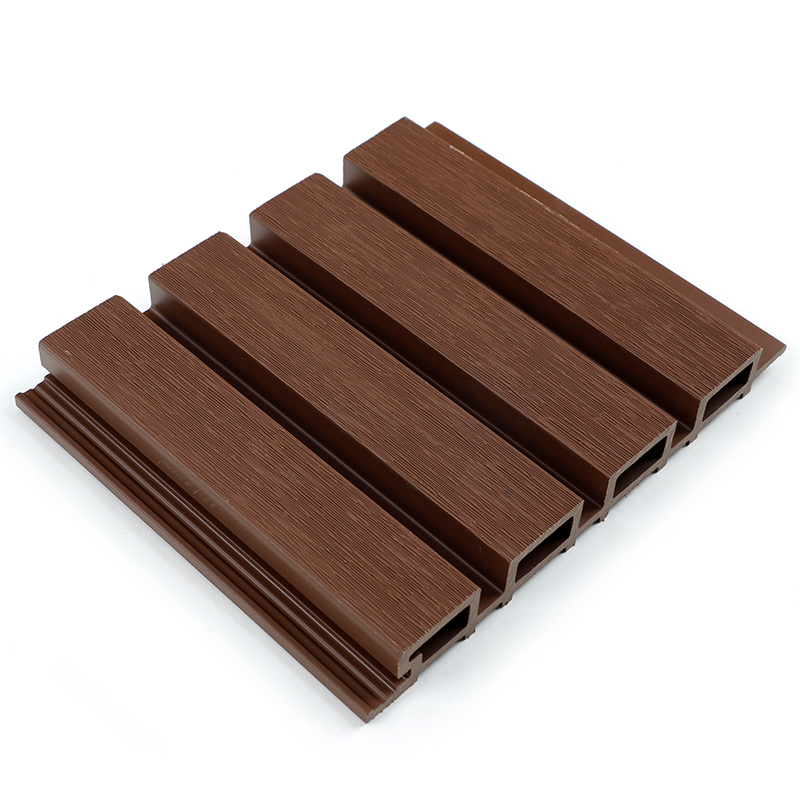
Fluted panels create repeated grooves and raised sections across a wall. This profile adds visual depth without requiring several different decorative materials. It can work well behind reception desks, in hotel lobbies, along office corridors, or around retail display areas. The final effect depends on groove spacing, panel width, color, and lighting direction. Narrow grooves can create a fine linear texture, while broader profiles produce a stronger architectural feature.
Designers should assess the entire wall rather than choosing a panel in isolation. Repeated lines can make a narrow space feel more elongated, but poorly planned joints may interrupt the visual rhythm. Corners, doors, sockets, and wall-mounted displays need careful coordination. A consistent installation layout helps maintain the intended pattern across the finished surface.
Cleaning requirements also deserve attention. Grooves may collect dust, especially in locations with limited access. Ask suppliers for cleaning guidance and check whether routine maintenance requires special tools. Do not assume every fluted panel has the same structural design. Solid and hollow profiles can differ in rigidity, weight, and fixing requirements.
Demax Group lists decorative choices such as WPC inner circular wall panels. This type of rounded profile offers a different visual effect from conventional straight grooves. Buyers should compare samples against the intended interior style before selecting a final design.
注释: Decorative profiles can affect cutting waste and installation time. Include pattern alignment and corner detailing in the original project estimate.
Commercial interiors often need to reflect a company's visual identity. Offices may use restrained finishes to support a professional environment. Hotels may prefer coordinated colors across guest-facing areas. Retail stores may need wall panels that complement product displays without competing for attention. Selecting a finish should therefore involve both the design team and the purchasing team.
Start with the approved color palette and identify the role of each wall. A feature wall may use a stronger tone, while surrounding surfaces remain neutral. Check how daylight and artificial lighting change the appearance of the finish. Gloss level, surface texture, and viewing angle can influence perceived color. Digital product images are useful for initial screening, but they cannot replace physical samples.
For multi-location projects, consistency becomes particularly important. Confirm whether the same finish can be supplied across different production batches. Record the approved sample, product code, dimensions, and acceptable color variation in the purchasing documents. If the project requires custom colors or sizes, request written confirmation of the specification and lead time. Also ask how the supplier handles repeat orders if later repairs become necessary. Keep an approved sample on site during installation. Use it to check incoming deliveries before the panels are distributed across different rooms or floors.
Solid and hollow profiles can serve different project requirements. A solid profile may offer greater material density, while a hollow profile may reduce weight and material use. However, these general differences do not determine performance on their own. Core composition, wall thickness, profile geometry, fixing methods, and support spacing all influence the installed result.
Buyers should ask suppliers for a cross-section drawing or technical specification. This helps confirm whether a panel has a solid core, internal cavities, reinforcement, or a particular locking design. Compare the information against the intended wall height, substrate, and expected use. If the wall may experience frequent contact, verify the product's documented impact resistance instead of relying on the profile name.
Weight is another practical consideration. Lighter panels may be easier to transport and handle, but the mounting system must still provide secure support. Solid panels may require different cutting tools or fixing arrangements. Contractors should also check whether the selected panel can accommodate the planned electrical outlets, access points, and decorative transitions.
Do not assume that two panels with similar dimensions have equivalent performance. Their materials and manufacturing methods may differ. Request product-specific documentation and assess each option against the same criteria.
Tip: Confirm the complete panel specification, including core composition, surface finish, weight, and fixing method. Avoid comparing products by appearance alone.
Panel dimensions influence material quantities, joint placement, cutting waste, and installation speed. Before requesting a quotation, prepare a measured wall schedule. Include wall height and width, door openings, windows, columns, corners, and other interruptions. These measurements help suppliers estimate the required quantity and identify possible layout problems before production begins.
Compare the panel's nominal size with its usable coverage. Some profiles overlap or interlock, so their effective coverage may differ from their full width. Ask the supplier to confirm the calculation method. Then estimate the required quantity for each wall separately. Add a suitable allowance for cuts, damaged pieces, and pattern matching, based on the layout and installation method.
Long panels may reduce horizontal joints but can create transportation and handling challenges. Shorter panels may be easier to move through existing buildings but can introduce more visible connections. The right choice depends on access restrictions, ceiling height, design preferences, and local installation conditions.
For a simple estimate, divide the total net wall area by the effective coverage per panel. Then adjust the result for layout waste and any manufacturer-specific packing rules. This calculation is only a starting point. Complex patterns and numerous openings require a more detailed cutting plan. Ask the supplier to review your measured drawings before confirming the order quantity. This can reduce shortages, excess stock, and avoidable delivery costs.
Commercial wall panels need to retain an acceptable appearance under routine use. Surface performance affects cleaning, repair frequency, and the visual quality of the finished space. Buyers should examine resistance to scratches, stains, scuff marks, and common cleaning agents. They should also ask whether the surface finish changes under prolonged exposure to the project's lighting conditions.
Request technical data where available. If the supplier provides test results, confirm the method used and whether it applies to the exact product being purchased. A general statement about durability does not establish a specific performance level. For busy commercial locations, consider arranging a sample assessment before approving the material. The project team can check cleaning behavior and surface appearance using representative conditions.
The finish should also match the intended maintenance routine. Smooth surfaces may be easier to wipe, while deeply textured profiles may need more attention around grooves. Strong cleaning chemicals can damage some coatings, so the cleaning team should follow the manufacturer's guidance. Establishing suitable maintenance procedures helps protect the finish and avoid unnecessary replacement.
Demax Group also offers a WPC surface plate for decorative interior applications. Buyers considering this type of product should verify its suitability for the specific surface and intended use rather than assuming that every decorative sheet is suitable for every application.
Tip: Request written cleaning instructions and product-specific test reports before specifying panels for heavily used commercial areas.
A suitable WPC wall panel can still produce poor results if the substrate or fixing method is unsuitable. Begin by inspecting the existing wall for unevenness, loose finishes, cracks, moisture, and other defects. The installation team should determine whether the surface needs repair, leveling, or additional support. These preparations affect alignment, adhesion, and the stability of the completed installation.
Different substrates may require different mounting arrangements. Depending on the product, installation may involve approved adhesives, mechanical fasteners, clips, battens, or a supporting framework. The correct method depends on the panel design, wall condition, project specification, and manufacturer's instructions. Do not assume that a method used for one panel will work equally well for another.
Adhesives need particular attention. Check substrate compatibility, curing time, temperature requirements, and the condition of the surface before application. Mechanical fixing may require accurate support spacing and suitable fasteners. Where a framework is necessary, contractors should verify its alignment before installing the panels. Poor preparation can lead to visible gaps, uneven lines, or loose sections.
Before work begins, arrange a site inspection and approve a sample installation where appropriate. This allows the team to review the fixing method, joint appearance, cutting quality, and interface with adjacent finishes. It also gives the project manager an opportunity to identify problems before they affect a large wall area. Include substrate preparation, fixing materials, and installation labor in the quotation. These items can significantly affect the total project cost.
Wall panels may respond to changes in temperature and humidity. The extent of movement depends on material composition, panel dimensions, environmental conditions, and installation design. If the system does not allow for the movement specified by the manufacturer, panels may buckle, separate, or develop visible gaps. Contractors should therefore review movement requirements before fixing the first panel.
Joint planning is especially important on long walls and continuous decorative surfaces. Establish the starting point, panel direction, corner details, and connection points before installation. Check how the panels meet skirting, ceilings, doors, window frames, and other finishes. These details affect both appearance and practical maintenance.
Large commercial projects may involve several trades working in the same area. Electrical outlets, lighting, signs, access panels, and built-in furniture can interrupt the wall layout. Coordinate these elements before cutting the panels. This reduces unnecessary rework and helps maintain a consistent decorative pattern.
The installation team should follow the product-specific instructions for gaps, edge clearances, and fastening. Avoid applying generic movement allowances without checking the actual panel requirements. Where conditions are unusual, request technical guidance from the supplier or a qualified installer. Approve a coordinated installation drawing before production or installation. It should identify panel joints, corners, openings, and movement allowances.
Installation efficiency matters when commercial spaces must remain operational. An office renovation may need to avoid peak working hours. A hotel may require phased installation to protect guest access. Retail projects may have fixed opening dates and limited periods for construction. The selected panel system should suit these practical constraints.
Consider panel size, weight, cutting requirements, fixing complexity, and the condition of the existing wall. A system that requires extensive leveling may take longer than expected, even if the panels themselves are easy to install. Custom colors or dimensions can also affect production lead times. Buyers should confirm these details before finalizing the project schedule.
A sample installation helps the team estimate actual productivity. Record the time required for measuring, cutting, fixing, joint finishing, and cleaning. Use these observations to plan labor requirements and identify potential bottlenecks. For large projects, divide the work into manageable zones and confirm delivery timing for each stage.
Material handling deserves equal attention. Check access routes, storage conditions, packaging, and the space available for cutting. Protect finished panels from damage before installation. Clear responsibilities between the supplier, contractor, and site manager can reduce delays caused by missing accessories or unclear specifications.
Tip: Request a written production and delivery schedule. Coordinate it with site readiness, installation capacity, and the building's operating calendar.
Panel prices alone do not provide a reliable basis for comparing commercial quotations. The total installed cost includes the panels, supporting materials, adhesives or fasteners, labor, cutting waste, finishing accessories, transport, and any necessary substrate preparation. Some projects may also require testing, mock-ups, or additional coordination. Buyers should identify these items before comparing suppliers.
Use the cost per finished square meter as a starting point. Confirm whether each quotation includes the same product dimensions, surface finish, usable coverage, and installation scope. A lower price per panel may not translate into a lower installed cost if the product generates more waste or requires additional support. Similarly, a more expensive panel may not offer better value unless its performance suits the application.
Consider the effect of project layout. Numerous corners, narrow wall sections, and complex patterns can increase cutting time and material waste. Long, uninterrupted walls may allow more efficient use of standard panel sizes. Ask suppliers to quote against the same measured drawings so the comparison reflects the actual project.
A clear quotation should specify the product reference, quantity, unit price, accessories, delivery terms, lead time, and exclusions. Where prices depend on order volume or customization, request written confirmation of the conditions. This makes budget approval and later invoice checks more straightforward.
Tip: Compare at least two quotations using the same technical specification and delivery scope. This helps separate genuine price differences from differences in what suppliers include.
Maintenance costs can influence the long-term value of commercial wall panels. A surface that cleans easily may reduce routine labor, while a finish that scratches or stains readily may require more frequent attention. Buyers should consider the cleaning products, staff time, access equipment, and repair procedures needed throughout the expected service period.
Ask the supplier for written care instructions. Confirm which cleaning agents are suitable and whether abrasive tools should be avoided. Textured profiles may require more detailed cleaning than flat panels. Areas near entrances, reception desks, and retail displays may also need more frequent inspection because of regular contact.
Replacement planning is important for large properties. A damaged panel should be replaceable without disrupting a substantial section of the wall. Ask whether replacement pieces can be ordered later and whether the supplier can identify the original color and finish. Retaining spare panels from the original batch may help address damage or future repairs. However, storage conditions should follow the manufacturer's recommendations.
Avoid relying on unsupported service-life claims. Actual performance depends on the product, installation quality, environment, and maintenance. Use documented warranty terms and relevant test information to assess risk. The project team should also check what the warranty excludes, including damage caused by incorrect installation or unsuitable cleaning.
Tip: Keep the approved product code, finish sample, installation records, and maintenance instructions in the building's handover documents.
The lowest initial price is not always the most economical option. Commercial buyers should consider the expected use of the space, maintenance demands, repair options, and the consequences of premature replacement. A high-visibility hotel lobby may justify a different specification from a temporary retail fit-out. The appropriate balance depends on project priorities and the consequences of failure.
A practical comparison should consider several factors together: installed cost, documented performance, cleaning requirements, warranty coverage, availability of replacement materials, and expected maintenance frequency. If reliable service-life data is unavailable, avoid assigning precise savings or payback periods. Instead, compare the evidence available for each shortlisted product and identify any remaining uncertainty.
Budget planning should also account for future changes. A commercial tenant may redesign a retail space after several years, while an office building may retain the same interior scheme for longer. Custom finishes can support a distinctive design, but buyers should consider the cost and lead time of future matching materials. Standardized finishes may offer more flexibility for phased renovations.
For procurement teams, the best decision is the one that meets the project's technical requirements without creating unnecessary lifecycle costs. Document the reasons for selecting the final product. This creates a clear basis for approval and helps explain the decision to owners, designers, contractors, and maintenance teams.
Tip: Use a weighted comparison scorecard if several products meet the minimum requirements. Give safety and technical compliance priority before comparing appearance and price.
Supplier evaluation should begin with evidence, not promotional descriptions. Request physical samples, product specifications, installation instructions, applicable test reports, and warranty conditions. Confirm that these documents refer to the exact panel under consideration. Similar-looking products may have different material compositions, finishes, and performance characteristics.
Samples help buyers assess color, texture, dimensional consistency, and surface quality. They also allow the design team to check whether the product works with other interior materials. For large projects, a sample wall or mock-up can reveal issues that are difficult to identify from photographs. These may include visible joints, inconsistent patterns, difficult corner details, or unexpected color changes under artificial lighting.
Technical documentation should cover the information needed for the intended application. Depending on project requirements, this may include material composition, dimensions, weight, installation methods, fire classification, emissions data, and relevant durability tests. Verify the issuing organization, test method, product identity, and document validity where applicable. Do not treat a general company certificate as proof that every product meets every project requirement.
Demax Group provides a range of decorative building materials through its product catalog. Buyers can use the catalog to identify potential options, then request product-specific documentation and samples before making a final decision.
Tip: Create a document checklist for every shortlisted product. Record which items have been received, reviewed, approved, or are still outstanding.
Customization can help commercial projects achieve a consistent design across different rooms or locations. Buyers may need specific colors, surface textures, panel dimensions, or decorative profiles. Before placing an order, confirm which options are available and whether the requested specification requires a minimum order quantity or extended production time.
The approved sample should become the reference for production. Record the product code, finish, dimensions, and any agreed tolerances. Ask the supplier how it controls color consistency and dimensional accuracy between production batches. These questions are especially important when the installation will take place in stages or across multiple buildings.
Customization also affects replacement planning. A unique finish may support brand identity, but it can be harder to match if the project expands later. Buyers should ask whether the same finish can be reordered and whether the supplier retains relevant production records. Where possible, purchase a reasonable quantity of spare material for future repairs.
Production planning should include packaging and delivery requirements. Confirm how panels will be protected against scratches, moisture, and handling damage during transportation. Ask how damaged goods are reported and resolved. Clear agreements on inspection, acceptance, and replacement help prevent disputes after delivery.
Tip: Treat the approved sample and written specifications as purchasing references. Verbal descriptions alone may not provide enough detail to resolve quality disputes.
A reliable supplier should explain how products are inspected before shipment. Ask about dimensional checks, surface inspection, packaging procedures, and the handling of nonconforming products. For a large commercial order, buyers may request a pre-shipment inspection or agree on a sample approval process. The inspection scope should match the project's risk and procurement requirements.
Delivery performance is another important consideration. Confirm production lead times, shipping arrangements, packing details, and the documents required for receiving goods. A delayed panel shipment can disrupt contractors and affect the handover date. For phased projects, coordinate deliveries with the installation schedule and available storage space.
After-sales support should be defined before purchase. Establish the procedure for reporting defects, submitting photographs, arranging replacements, and resolving technical questions. Confirm the warranty period, covered defects, exclusions, and any installation conditions that affect coverage. Written terms make expectations clearer for both parties.
Buyers should also assess communication quality. Suppliers that respond clearly to technical questions can help project teams identify problems earlier. However, responsive communication should complement, not replace, product documentation and quality checks. A sound purchasing decision considers technical suitability, production capability, delivery reliability, and the supplier's ability to support the project after shipment.
Tip: Include inspection criteria, delivery milestones, and defect-resolution procedures in the purchase agreement for large or time-sensitive projects.
An attractive finish can improve a commercial interior, but appearance should not determine the entire specification. A panel may match the design concept while failing to meet the project's fire performance, dimensional, cleaning, or installation requirements. Buyers should evaluate decorative appeal alongside documented technical suitability.
Start by defining minimum requirements before comparing colors and textures. Confirm the intended location, exposure conditions, substrate, and applicable building standards. Then shortlist products that meet these requirements. This process prevents the team from investing time in a visually appealing option that cannot be approved for the project.
Another common mistake is relying entirely on online photographs. Screen settings, lighting, and image processing can alter perceived color and texture. Physical samples provide a more reliable basis for approval. For feature walls, a larger mock-up may be necessary to assess pattern repetition and joint visibility.
Buyers should also consider the complete installation. Panel edges, corners, transitions, and fixing details influence the finished appearance. A high-quality panel can still look poor when installed on an uneven wall or combined with unsuitable accessories. Coordinating material selection with installation planning reduces this risk.
Tip: Approve the complete wall system, not just the panel's decorative surface. Include the substrate, fixing method, joints, and finishing details in the review.
Commercial building requirements vary by location, occupancy, and application. A panel accepted for one project may not satisfy another project's specifications. Hotels, offices, retail spaces, and public buildings can have different fire safety and indoor environmental requirements. Buyers should identify the applicable rules before finalizing material selection.
Request the relevant documents and confirm that they match the proposed product. Where fire performance is specified, check the required classification and test evidence. Where emissions limits apply, verify the relevant test results and assessment standards. If the project requires a tested wall assembly, confirm whether the documentation covers the complete system or only the individual panel.
Installation materials also matter. Adhesives, sealants, substrates, and supporting components may be subject to separate requirements. Compliance should therefore be assessed across the intended installation rather than inferred from one product description.
When documentation is unclear, consult the architect, fire consultant, or other qualified professional responsible for project compliance. Resolve questions before ordering or installing the material. Replacing a noncompliant finish after installation can cause substantial delays and additional costs.
Tip: Make technical approval a formal procurement milestone. Do not release the full order until the required compliance documents have been reviewed.
Bulk orders create risks when dimensions, finishes, or quantities have not been checked carefully. A small error in panel width can affect coverage calculations across a large wall. An unapproved color may also create visible differences between rooms. These problems are easier to prevent during procurement than to correct after delivery.
Before ordering, verify the measured wall area and effective panel coverage. Check the number of corners, openings, and transitions. Confirm the cutting allowance, packaging quantity, accessories, and any minimum order requirements. Ask the supplier to review the layout when the design includes complex patterns or custom dimensions.
The purchase order should identify the exact product, finish, size, quantity, and approved sample. It should also state delivery requirements, inspection procedures, and the process for handling damaged or incorrect goods. For phased projects, confirm whether later batches can match the approved finish and whether additional stock will remain available.
Finally, plan the delivery around site readiness. Panels should not arrive too early if the site lacks suitable storage. They should not arrive too late if contractors are ready to install them. Coordinating procurement, transport, and installation helps reduce handling damage, storage problems, and schedule disruption.
Tip: Complete a final order review against the approved drawings, sample, technical specification, and delivery schedule before authorizing production.
Choosing the right WPC wall panel requires balancing design, durability, safety, installation, and long-term costs. Demax Group offers decorative wall panels for diverse commercial interiors. Its customizable designs help meet different project needs. Verify product specifications and samples before ordering to ensure reliable results.
A: Compare durability, thickness, finish, safety compliance, and installation requirements.
A: Yes, suitable designs offer decorative appeal and easy maintenance.
A: Total costs include panels, labor, accessories, transport, and maintenance.
A: Choose based on rigidity, weight, mounting requirements, and application.
A: Request samples, technical specifications, test reports, and warranty terms.


