


English
Views: 0 Author: Site Editor Publish Time: 2026-08-03 Origin: Site


Substrate moisture is one of the most important site conditions to check before installing Interior WPC Wall Panels. A wall panel may have good moisture-resistant performance, but the wall behind the panel still needs to be dry, clean, flat and stable before installation. If the substrate is damp, dusty, soft or unstable, the panel may not bond properly, and installation problems may appear after the wall is finished.
Before installing Interior WPC Wall Panel products, contractors should confirm whether the wall substrate is dry, clean, flat and stable enough for bonding or mechanical fixing.
Substrate moisture can come from newly plastered walls, wet putty layers, uncured paint, water seepage, humid rooms, old walls, hidden condensation or poor ventilation. These problems may reduce adhesive bonding, slow adhesive curing, weaken the wall surface, trap moisture behind panels and increase the risk of lifting, gaps, odor, mold or rework.
This article explains how substrate moisture affects Interior WPC Panel installation and what buyers, contractors and project managers should confirm before installation begins.
Substrate moisture affects Interior WPC Wall Panel installation because it changes how the panel bonds, fits and stays stable after fixing.
Key points include:
A dry substrate helps adhesive bonding and panel adhesion.
A damp wall may weaken the adhesive layer.
Wet putty or uncured paint can peel under the panel.
Powdery or loose wall surfaces reduce bonding strength.
Hidden water seepage can cause long-term installation failure.
High room humidity may slow adhesive curing.
Mold or mildew should be treated before installation.
The wall surface should be clean, dry, flat and stable.
Substrate moisture should be checked before cutting and fixing panels.
Project orders should confirm wall type, room condition and installation method before delivery.
A practical preparation process can be shown as:
Moisture Check → Surface Cleaning → Drying / Repair → Adhesive Readiness → Panel Fixing → Final Bond Review
In wall panel installation, substrate means the base surface behind the panel. It may be a cement wall, plaster wall, drywall, painted wall, old tile surface, wood board or other interior wall base.
Substrate moisture means moisture held in or on that wall base. It may be visible as damp patches, condensation, peeling paint, mold, soft putty or water stains. It may also be hidden behind paint, wallpaper, old coatings or repaired wall areas.
Common sources of substrate moisture include:
newly plastered walls that are not fully dry;
fresh putty or leveling compound;
uncured paint or primer;
water seepage from pipes or exterior walls;
old walls with damp patches;
rooms near bathrooms, basements or kitchens;
high indoor humidity;
poor ventilation;
condensation near cold walls;
walls cleaned with water shortly before installation.
For Interior WPC Wall Panel installation, substrate moisture should be checked before panels are fixed, not after problems appear.
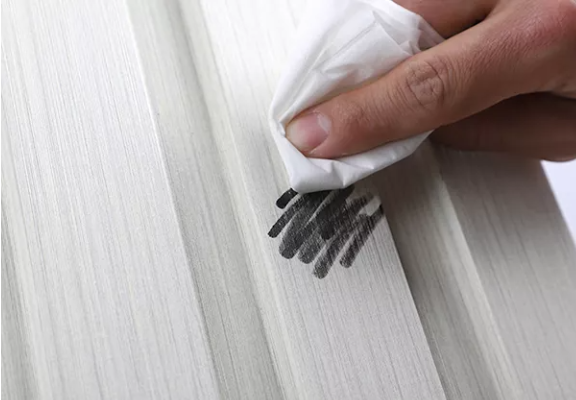
A dry wall surface supports installation stability. It helps the adhesive attach to the wall correctly and gives mechanical fixing points a more stable base. It also reduces the risk of trapped moisture behind panels.
A dry substrate helps with:
stronger adhesive bonding;
more stable panel positioning;
smoother installation surface;
reduced edge lifting risk;
better wall-to-panel contact;
more predictable adhesive curing;
lower odor and mold risk;
fewer post-installation repairs.
Interior WPC Wall Panels may offer moisture-resistant performance, but the installation system still depends on the wall behind the panel. If the wall is damp, soft, powdery or peeling, the panel may attach to a weak surface instead of a stable base.
This is why surface preparation is a practical quality step, not only a site cleaning task.
Adhesive bonding is very sensitive to wall condition. When the substrate is damp, the adhesive may not cure properly or may not grip the surface evenly. If the wall layer is weak, the adhesive may bond to loose dust, soft putty or peeling paint instead of the structural wall.
For indoor decorative products such as WPC Fluted Wall Panel, substrate moisture should be checked before adhesive application, panel positioning and clip fixing.
| Moisture Issue | Possible Installation Problem |
|---|---|
| Damp cement wall | Adhesive may not bond firmly |
| Wet putty layer | Surface may soften or peel |
| Uncured paint | Adhesive may attach to weak coating |
| Moldy wall | Odor and hygiene issues may remain |
| Powdery wall surface | Adhesive may bond to dust, not wall |
| Hidden seepage | Panels may lift after installation |
| High humidity room | Adhesive curing may slow down |
| Uneven damp patches | Panel surface may look uneven after fixing |
The acceptable moisture condition should follow adhesive instructions, substrate type, project requirement and supplier guidance.
Panel lifting and gaps are common installation problems when the wall surface is not ready. A damp substrate can weaken the bond between the panel and wall. Once the adhesive loses strength or the wall layer softens, panel edges may lift, joints may open or the surface may look uneven.
Damp substrates may cause:
weak panel adhesion;
edge lifting;
hollow areas behind the panel;
uneven joint lines;
visible WPC wall panel gaps;
panel movement after fixing;
trim misalignment;
adhesive failure;
odor behind panels;
mold risk;
project rework.
These problems are often more difficult to fix after installation. Removing panels, cleaning adhesive and repairing wall areas can increase labor cost and delay the project.
The best approach is to inspect the wall before installation and solve moisture problems before the panels are installed.
Different wall substrates have different moisture risks. A cement wall may hold moisture after construction. A plaster wall may look dry on the surface but still contain moisture inside. A painted wall may have weak or uncured coating. An old wall may have hidden seepage or mold.
| Substrate Type | Moisture Concern |
|---|---|
| New cement wall | May need enough drying time before panel fixing |
| Plaster wall | Moisture may remain under the surface layer |
| Putty or skim-coated wall | Wet or weak layer may peel under adhesive |
| Painted wall | Uncured or peeling paint may reduce adhesion |
| Drywall | Moisture damage can weaken the board surface |
| Old wall | Dust, mold, seepage or loose coating may remain |
| Tile surface | Surface must be clean, dry and suitable for bonding |
| Wood board base | Moisture and deformation should be checked |
The installer should not assume that a wall is ready because it looks smooth. Smoothness and dryness are different conditions. Both should be checked.
Wall readiness should be checked before Interior WPC Wall Panel installation begins. The goal is to confirm that the substrate can support bonding or mechanical fixing.
| Check Item | What to Confirm |
|---|---|
| Wall dryness | No visible damp patches or condensation |
| Wall flatness | Surface is even enough for panel contact |
| Surface strength | No loose plaster, dust or peeling paint |
| Cleanliness | No oil, grease, dust or construction residue |
| Crack repair | Cracks and holes are filled and dried |
| Mold treatment | Mold is removed before installation |
| Room ventilation | Airflow helps drying and adhesive curing |
| Installation timing | Panels are installed after substrate is stable |
Useful site checks include:
look for damp patches or water marks;
touch the wall for cool or wet areas;
check if paint or putty peels easily;
wipe the surface to see if powder comes off;
inspect corners and lower wall areas;
check whether repaired areas have dried;
confirm whether the room has enough ventilation;
follow adhesive manufacturer guidance if a moisture test is needed.
If there is clear water seepage, panel installation should be delayed until the source is repaired.
A damp or unstable wall should be treated before panel installation. Covering a moisture problem with panels may hide it temporarily, but it can create larger problems later.
Preparation may include:
improving ventilation;
allowing the wall to dry fully;
repairing water leakage or seepage;
removing mold or mildew;
scraping loose paint or putty;
cleaning dust and construction residue;
repairing cracks and holes;
leveling uneven wall areas;
applying suitable primer if required;
confirming adhesive compatibility;
checking wall condition again before fixing.
The wall should be dry, clean, flat and stable before panels are cut and installed. If the room is still under wet construction work, such as plastering, painting or floor leveling, it may be better to wait until the environment is more stable.
For project installations, Demax Decor can help confirm whether the wall should be dried, cleaned, repaired or prepared before adhesive bonding, nailing or clip fixing begins.
Different installation methods have different moisture sensitivity, but all methods need a stable wall base.
| Installation Method | Moisture Concern |
|---|---|
| Adhesive bonding | Requires dry, clean and stable surface |
| Nailing installation | Wall base should still be firm and not powdery |
| Clip installation | Substructure must be stable and dry |
| Combined adhesive and clips | Both bonding surface and mechanical support matter |
| Installation over old wall | Old paint, dust, moisture and looseness must be checked |
| Large project installation | Moisture differences between areas should be reviewed |
Adhesive bonding is usually the most sensitive to moisture because the adhesive layer depends directly on surface condition. Nailing or clip fixing can provide mechanical support, but a damp or weak wall can still cause long-term instability.
For large projects, moisture may vary between rooms, floors or wall zones. One area may be dry while another area is not ready. Project managers should not approve all walls based on one sample area.
Several common mistakes can lead to WPC wall panel installation problems.
Avoid these issues:
installing panels on a damp wall;
installing before new plaster or putty is dry;
applying adhesive over peeling paint;
bonding panels to powdery wall surfaces;
ignoring mold or mildew;
covering water seepage with panels;
installing in rooms with poor ventilation;
using adhesive before checking compatibility;
skipping wall flatness checks;
installing over dusty construction residue;
fixing panels before repaired cracks are dry;
starting installation without checking room humidity.
These mistakes can weaken panel adhesion and create lifting, gaps, odor or rework after installation.
Before placing an Interior WPC Wall Panel project order, buyers should confirm site conditions and installation requirements. This helps the supplier and contractor prepare the correct product, packaging and installation guidance.
| Buyer Question | Why It Matters |
|---|---|
| What is the wall substrate type? | Different substrates have different moisture risks |
| Is the wall fully dry? | Supports adhesive bonding and installation stability |
| Is there water seepage? | Must be repaired before installation |
| Is the wall flat and clean? | Helps panels contact the surface properly |
| Will adhesive, nails or clips be used? | Affects installation preparation |
| Is the room humid? | May slow adhesive curing |
| Is the project newly renovated? | Wet construction work may still be drying |
| Is this a large project order? | Moisture differences between areas should be checked |
A moisture-related installation issue is often easier to prevent than repair. For project orders, buyers should ask for wall readiness guidance before panels are delivered to the site.
Demax Decor supports Interior WPC Wall Panel supply for residential decoration, hotels, offices, restaurants, commercial spaces and custom interior projects. For better installation results, wall condition should be reviewed together with panel profile, fixing method and site schedule.
Demax Decor can help review:
wall type;
room condition;
substrate moisture concern;
panel profile;
installation method;
adhesive or mechanical fixing;
wall flatness;
wall cleanliness;
project quantity;
delivery schedule;
packaging method;
custom size request;
installation sequence;
pre-installation preparation needs.
If you are preparing Interior WPC Wall Panels for a project, Demax Decor can help review wall type, substrate condition, room humidity, fixing method, panel profile and installation schedule before production or delivery.
Substrate moisture affects Interior WPC Wall Panel installation by weakening adhesive bonding, reducing wall surface stability, slowing adhesive curing, trapping moisture behind panels and increasing the risk of lifting, uneven joints, gaps, odor, mold or rework. Even when WPC panels offer moisture-resistant performance, the wall substrate should still be dry, clean, flat and stable before installation.
A good installation plan should start with wall readiness. Contractors should check substrate moisture, wall flatness, surface strength, cleanliness, crack repair, mold treatment, room humidity and ventilation before cutting or fixing panels.
Need help reviewing wall readiness, adhesive method or project installation conditions? Contact Demax Decor for Interior WPC Wall Panel installation support with your wall type, room condition, fixing method, panel profile and project quantity.
Substrate moisture means moisture in or on the wall base behind the panel, such as cement, plaster, drywall, painted wall, old wall or tile surface.
Yes. A damp substrate can weaken adhesive bonding, slow adhesive curing, reduce wall surface strength and increase the risk of panel lifting or gaps.
It is not recommended. Even if the panel itself has moisture-resistant performance, the wall surface should still be dry, clean, flat and stable before installation.
Moisture can prevent adhesive from gripping the wall properly, slow down curing or cause the adhesive to attach to a weak surface layer instead of a stable substrate.
Check wall dryness, flatness, surface strength, cleanliness, cracks, holes, mold, water seepage, room humidity and ventilation.
No. Mold, mildew or water seepage should be treated before installation. Covering the problem may trap moisture behind the panels.
Yes. Nailing or clip fixing can provide mechanical support, but the wall base should still be firm, dry and not powdery or loose.
Yes. Newly plastered, skim-coated or repaired walls should dry and become stable before Interior WPC Wall Panels are installed.
Ventilation helps reduce room humidity, supports wall drying and may help adhesive curing after installation.
Yes. Demax Decor can review wall type, room condition, fixing method, panel profile and project quantity to support Interior WPC Wall Panel installation planning.


